ALMATY – As Michelle Yerkin prepares to conclude her tenure as the United States Consul General in Almaty, she leaves Kazakhstan at a moment of deepening engagement between the two countries. For Yerkin, who first served in Almaty two decades ago in 2003, the posting has been both a professional milestone and a personal journey that reflects how much both countries have changed.
U.S. Consul General Michelle Yerkin. Photo credit: US Consulate General in Almaty.
“It is really a special time in the U.S. and Kazakhstan relationship, and I feel very honored to have been a part of that,” Yerkin said in an interview with The Astana Times. “Right now, lately, over the last year, we have seen unprecedented attention from the U.S. on Kazakhstan, including a number of high-level visits.”
She highlighted several senior-level engagements that took place over the past year, including visits by U.S. Special Envoy for South and Central Asia Sergio Gor, Deputy Secretary of State Christopher Landau, CEO of the U.S. International Development Finance Corporation Ben Black and Assistant Secretary of Commerce David L. Fogel.
Expanding economic ties and new opportunities
According to Yerkin, the increased diplomatic attention has contributed to positive momentum, particularly in economic and commercial cooperation.
U.S. Consul General Michelle Yerkin during official visits to communities across the Almaty Region. Photo credit: US Consulate General in Almaty.
Economic cooperation has become one of the key areas in U.S.-Kazakhstan relations. Yerkin pointed to recent business initiatives and agreements as examples of the expanding partnership between the two countries.
Today, she said, more than 600 U.S. companies operate in Kazakhstan, with many of them based in Almaty, the country’s commercial and financial center.
One of the initiatives Yerkin also highlighted was the development of business connections through trade delegations. She emphasized that cooperation has moved beyond traditional exchanges, with companies exploring opportunities across wider regional markets.
Yerkin also pointed to the SelectUSA initiative, organized by the U.S. Department of Commerce, which supports foreign investment in the U.S.
“Over the past two years, Kazakh businesses interested in entering the U.S. market have participated in large delegations to explore investment opportunities. So it goes both ways, and it’s benefiting both of our countries,” she said.
Education, culture and connections between people
The Astana Times news reporter Ayana Birbayeva speaks with U.S. Consul General Michelle Yerkin during an interview at the American Space in Almaty. Photo credit: US Consulate General in Almaty.
While economic cooperation has been a major focus of Yerkin’s work, she emphasized that the foundation of the bilateral relationship extends far beyond business agreements. Yerkin said she has been especially impressed by the growth of cultural and educational cooperation, including the development of American Spaces across the country.
“This space is an example,” she said, referring to the American Space in Almaty. “We have 10 of these spaces across the country, and seven of them actually in partnership with Chevron.”
She explained that today’s American Spaces offer much more than the traditional library model, providing opportunities for young people to participate in robotics, 3D printing, STEM classes and English-language programs.
According to Yerkin, since the Makerspace program began in 2020, 38,000 people have participated in American Space programs. Since Kazakhstan’s independence, U.S. cultural and educational initiatives have built a network of 22,000 alumni across the country.
Diplomacy beyond policy
Reflecting on what lessons she will carry into future assignments, Yerkin said diplomacy extends beyond official meetings, agreements or foreign policy discussions. The strongest foundation of international relations is built through individual experiences and personal ties.
“I think the biggest lesson I take away is that diplomacy is not just about foreign policy. It is about people-to-people connections, and these are the bridges that should last,” Yerkin said.
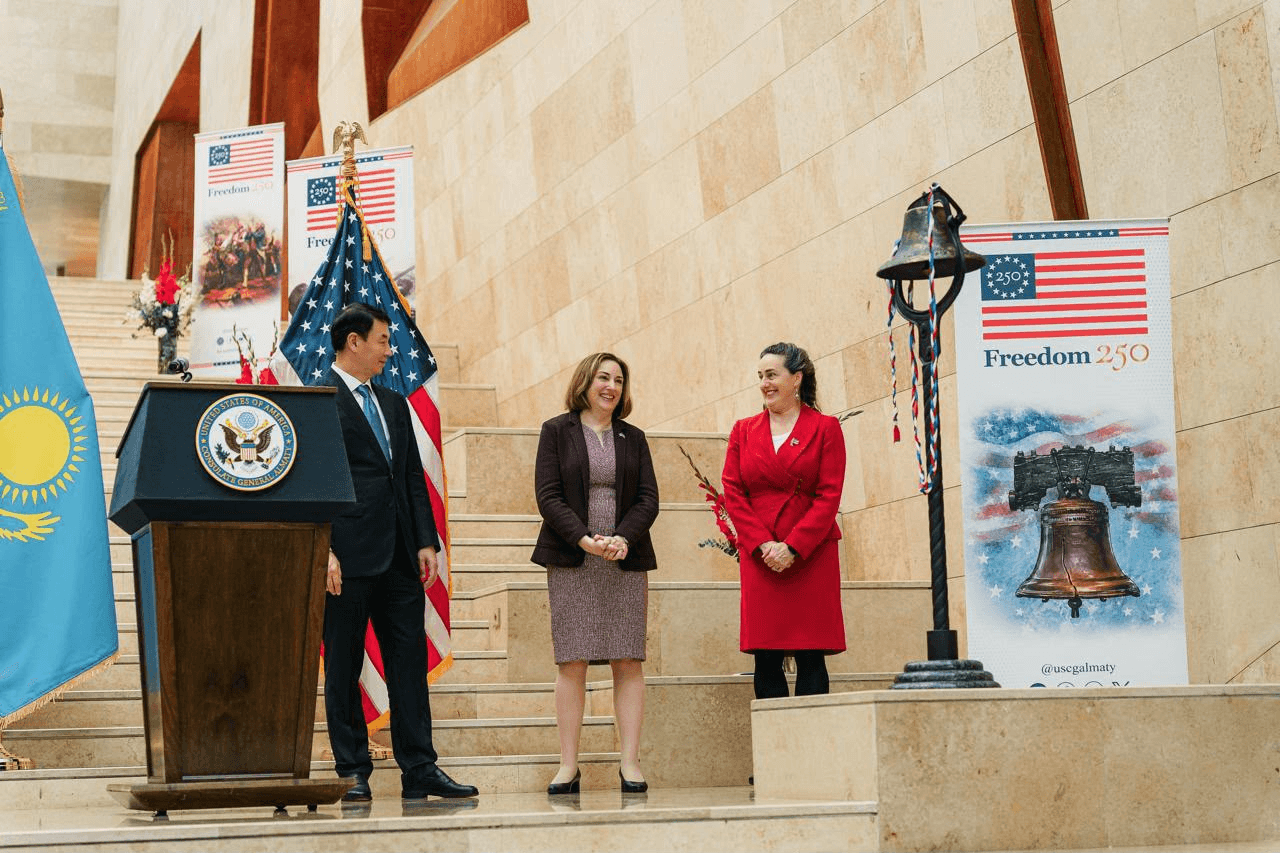
From L to R: Akim (Mayor) of Almaty Darkhan Satybaldy, U.S. Ambassador to Kazakhstan Julie M. Stufft, and U.S. Consul General in Almaty Michelle Yerkin during the reception on the occasion of the U.S. Independance Day. Photo credit: US Consulate General in Almaty.
She noted that Kazakhstan’s reputation as a bridge between cultures and regions is reflected not only in official cooperation but also in the stories of thousands of people who connect the two countries through education, business and everyday life.
“I see the development of the relationship of our two countries through the lens of all of the people. Not just alumni, but even the Americans who come here to start businesses,” she said.
During her travels across Kazakhstan, Yerkin said she was often surprised to discover Americans involved in different fields across the country from volunteering and teaching to entrepreneurship. She recalled meeting an American entrepreneur in the Almaty Region who grows popcorn using seeds imported from the U.S.
A personal connection with Kazakhstan
Yerkin first came to the country more than 20 years ago, and her return offered a chance to reconnect with a place that had become personally meaningful to her.
Yerkin at Charyn Canyon in the Almaty Region during her first diplomatic posting in Kazakhstan and after returning to the country two decades later. Photo credit: US Consulate General in Almaty.
“I have my own personal connections to Kazakhstan, because I met my husband here in Almaty over 20 years ago,” she said. “It has been great for us coming back, especially for our kids to know and experience the Kazakh culture after many, many years of traveling the world together.”
In 1993, Yerkin worked on the first pilot program that later became known as the Future Leaders Exchange (FLEX) program, which brought students from across the former Soviet Union to study in the U.S.
At the time, the initiative was new and was designed to create opportunities for young people from countries with which the U.S. had limited previous interaction.
“I worked on the first program, and the next year I told my parents that they should host a student from this program. And they hosted a boy from Kazakhstan,” Yerkin said.
“He lived with my family for a year in high school, and then when I came back in 2003, we reconnected. Now he comes every year to our Independence Day party that we have. We are very close. He is my Kazakh brother, my first Kazakh family before I had my husband and my kids,” she said.
Alumni networks and the long-term impact of exchanges
U.S. Consul General Michelle Yerkin with Mirzhan Kusmanov, a FLEX exchange alumnus from Ust-Kamenogorsk, during his exchange year in the United States back then and now. Photo credit: US Consulate General in Almaty.
Throughout her tenure, Yerkin had the opportunity to meet graduates of the U.S.-supported educational programs who later became active in Kazakhstan. She highlighted the example of Sayasat Nurbek, Kazakhstan’s Minister of Science and Higher Education, who participated in an exchange program.
“We met another alumni in Turkistan. He is the director of the Turkistan International Airport,” she said. “He learned so much from his experience and he is working, trying to find ways to incorporate some U.S. technology in the airport and has big plans for expanding the airport as a cargo and transport hub.”
“We have a very vibrant network of 22,000 alumni. We like to stay in touch, and then we invite people to events like this one,” she added, encouraging alumni to remain connected and continue participating in the network.
Carrying Kazakhstan forward
Returning to Kazakhstan after two decades also allowed Yerkin to see how remarkably the country has changed. Turkistan, Shymkent and Taraz are among the places that left the strongest impression on Yerkin.
She highlighted Turkistan as an example of Kazakhstan’s tourism development.
Yerkin’s family in Kazakh traditional clothes. Photo credit: US Consulate General in Almaty.
“There is much more infrastructure for tourism, so it is exciting to see how that has been developed as a tourist site,” Yerkin said.
Comparing her first assignment with her more recent posting, she pointed to the scale of urban development across the country. She also recalled her early impressions of Astana, where she worked as the U.S. diplomatic mission was preparing to move from Almaty.
“One of the things that I think is kind of a fun fact is I still work in the same building that I worked in 20 years ago. But 20 years ago, it was the embassy of my time. We were preparing to move to Astana,” Yerkin said.
Reflecting on what she will take with her moving forward, Yerkin reiterated the importance of the relationships she built and the personal ties that shaped her time in the country.
“The thing that has been the most enriching is the people, the memories we have made. I will definitely carry them with me when I go, wherever I go. And we will always follow Kazakhstan because it’s a piece of my heart, it’s a piece of my family,” she said.
Yerkin added that her connection with the country will continue beyond her diplomatic assignment. “We have family ties. We will definitely come back in our personal capacity,” she said.
Get The Astana Times stories sent directly to you! Sign up via the website or subscribe to our X, Facebook, Instagram, Telegram, YouTube and Tiktok!