![[UN: July 3] Honoring US Naturalized Citizens, Gaza's Incredibly Shrinking Territory & Lots More](/_next/image?url=https%3A%2F%2Fpassblue.com%2Fwp-content%2Fuploads%2F2026%2F07%2FAnda-Filip-3.jpg&w=3840&q=75)

This Week @UN: Trump’s big Iran failures; dual citizenships in SecGen race; more “policy profiles” of SG candidates; IOM’s role in US deportations; keeping HQ’s lights on.
Plus: Israel shrinks Gaza; progress ending the “inhumane”death penalty; AI warnings; Russia clobbers humans in Kyiv; Tibetan’s self-immolation.
Did someone forward this email to you? Stay sharp & subscribe here!
• We encourage you to follow us on LinkedIn, Blue Sky, Twitter (X), Facebook, and Instagram, .
• Our #1 story: Will Secretary-General Candidates’ Dual Citizenships Trip Them Up?, by Damilola Banjo
• As we mark the 250th birthday of the US — of which several PassBlue staff are citizens, albeit ones whose ancestors sailed to the New World from such places as England, Wales, Scotland, Ireland (dia duit, Munster), Germany, Estonia and Latvia (plus we pay tribute to our Nigerian staffer, Damilola) — we wish everyone a day of hot dogs, fireworks and other celebratory goodies for our precious freedoms, including the ever-dwindling freedoms of expression and press. And so we share “‘This Is My Country Now,’” a photo essay from Documented of a ceremony in Oyster Bay, N.Y., for just-naturalized citizens, in time for the 4th.
• Honoring “distinguished” naturalized citizens in the US on the 4th: 25 Distinguished Naturalized Citizens Honored by the Andrew Carnegie Foundation on America’s 250th Anniversary
PassBlue this week:
• The High Costs and Failed Ambitions of Trump’s War, Legally Speaking column, by Mona Ali Khalil
• Will Secretary-General Candidates’ Dual Citizenships Trip Them Up?, by Damilola Banjo (#1 story)
• María Fernanda Espinosa Faces the General Assembly (policy profile produced with 1 for 8 Billion campaign)
• Carolyn Rodrigues Birkett Faces the General Assembly (policy profile produced with 1 for 8 Billion campaign)
• How a UN Agency Helps to Enable the US Policy on Third-Country Deportees, by Anna Oakes
• ‘We’ve Prevented a Crash,’ Says UN Controller About the Organization’s Cash Woes, by Damilola Banjo
• No Statue of Peace here: In April, a local board in Auckland, New Zealand, turned down a proposal to erect a statue commemorating “comfort women,” the approximately 200,000 women forced into sexual servitude for the Japanese Imperial Army from 1932 to 1945. The rejected “Statue of Peace” depicts a girl seated next to an empty chair. This design commemorates both the women and girls who survived the barbaric “comfort” system as well as the 75 to 90 percent of victims who died either by suicide or the subhuman conditions forced on them.
Dozens of copies of the statue exist worldwide, and each host site underwent its own embattled procedure to erect the sculpture. The original one faces the Japanese Embassy in Seoul, South Korea, a permanent reminder that Japan has failed to issue a formal apology to survivors. The barricades surrounding the statue, installed in 2017 “as far-right groups denying the Japanese military’s sexual enslavement of women during World War II held counter-rallies nearby,” according to Korea Times, were dismantled only two months ago. The Berlin central borough’s own installation was persistently opposed since its construction in 2020 by a public statement from the Japanese Embassy in Berlin and several private conversations between Japanese authorities and the German government.
Ultimately, the Japanese state’s pressure pushed Berlin-Mitte to order the statue’s removal in October 2024. Auckland’s board declined to approve the construction of its a Statue of Peace after “formal representations” from the Japanese government on the matter. The refusal demonstrates the continued repercussions of the Japanese state’s 80-year-long campaign to deny the “comfort” system, perpetrating a culture of impunity for crimes of sexual violence. The international order’s current behavior perpetuates the misconception that strong geopolitical positioning cannot coexist with justice for survivors. But this is not a zero-sum game. Strong geopolitical alliances do not need to deny the largest system of sexual servitude in modern history. Diplomatic harmony should not come at the expense of women’s rights. Women’s rights should not be sacrificed. They should be the norm. – LAUREL HOLLEY, reporting from Washington D.C.
Top UN news:
Monday, June 29
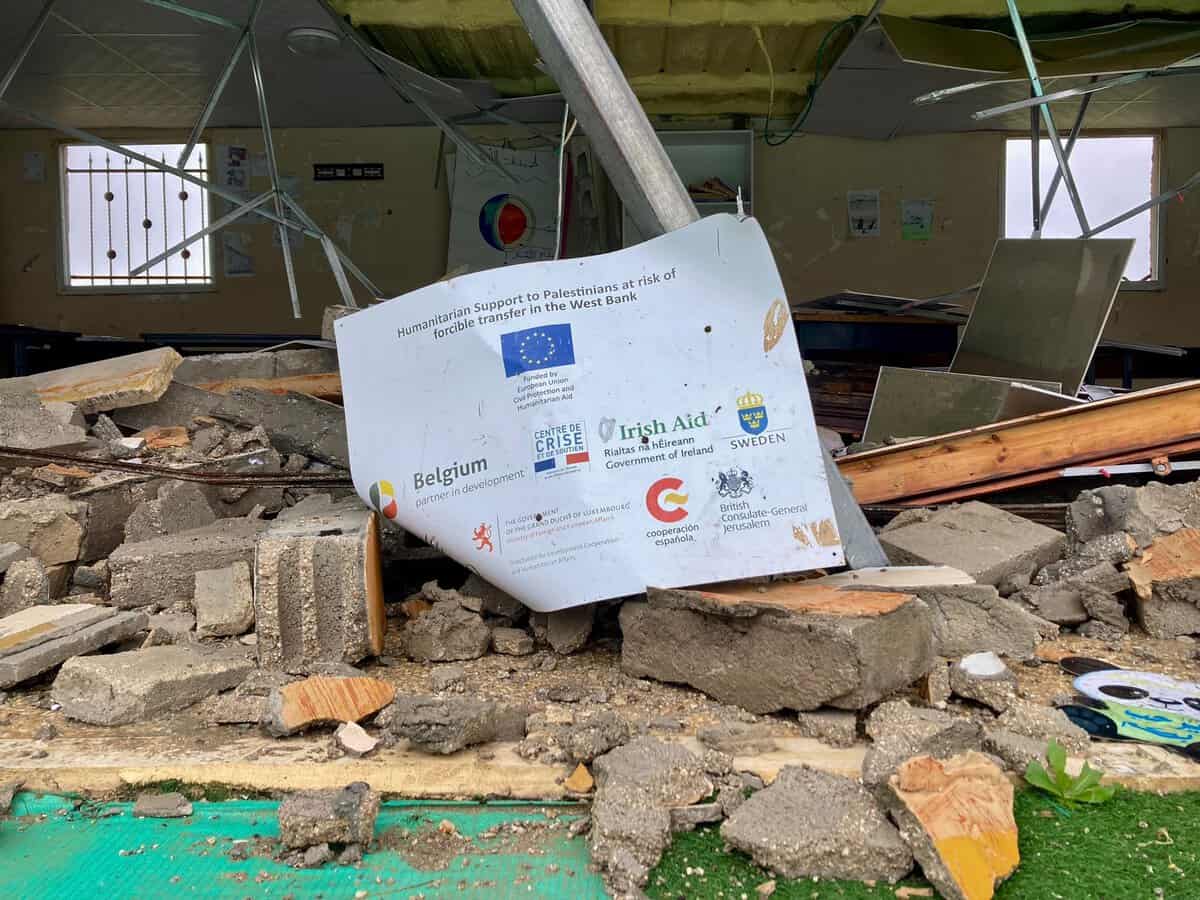
• Spokesperson’s briefing: Calling from Jerusalem, the deputy special coordinator for the Middle East Peace Process, Ramiz Alakbarov, told the UN Security Council that “Israeli airstrikes and military operations” since the October 2025 ceasefire have killed 1,000 people across Gaza, leaving sanitation conditions in the enclave “alarming,” 70 percent of Gazans without “dignified shelter” and imposing “persistent constraints” on essential humanitarian efforts. Alakbarov also reiterated Secretary-General António Guterres’s “strong condemnation of the relentless expansion and acceleration of Israeli settlements in the West Bank.”
The UN is assessing the needs of 20-plus families in eastern Deir al-Balah (Gaza) and over a dozen more in eastern Gaza City who have been displaced by expansions of the “Yellow Line,” which halves the territory accessible to Palestinians in Gaza, despite Israel expanding the areas where humanitarians’ movements are restricted, known as the “Orange Line,” on June 23. The latest expansion of the Orange Line usurps another 800 square meters where Israeli authorities urge the UN and humanitarian partners to coordinate their movements, the UN says. Yet, UN humanitarian partners warn that having to coordinate every movement with Israel in most of Gaza “undermines” service provisions, adding that the effect “ranges from higher operational costs and delays to a complete cutting off of essential facilities, such as Gaza’s two sanitary landfills.”
On June 29, the Office for the Coordination of Humanitarian Affairs (OCHA) said humanitarian teams in Gaza were assessing the needs of those affected by the June 28 Israeli airstrike on Al Muwasi area of Khan Yunis. Initial information suggests that – in addition to the killing of a mother and her baby girl — more than 150 families had their tents destroyed. The tents of 250 other families were also damaged. Meanwhile, health officials warn of a rise in chickenpox across Gaza. In just two weeks, they recorded nearly 9,300 cases across more than 130 health facilities. Over half of the cases were in Khan Yunis. The UN says the surge is linked to “deteriorating environmental conditions, overcrowding, and sanitation and hygiene gaps.”
On July 2, Stéphane Dujarric, UN spokesperson, said of ending the now-1,000 days of the Israeli-Hamas war: “We need to see greater humanitarian access. We need to see the withdrawal of Israel from Gaza. We need to see a unified Palestinian political presence that is the same in the occupied West Bank as it is in Gaza. And we need all of the parties to recommit to a two-state solution and the international community to support them.”
Tuesday, June 30
• Spokesperson’s briefing: Opening the 9th World Congress Against the Death Penalty in France, Guterres said in a pre-recorded video that “movement toward universal abolition is advancing,” with more countries “committing to end this cruel practice,” but that progress “cannot be taken for granted, requiring “vigilance, courage, and sustained resolve.” Guterres added that the “inhumane form of punishment, which is still practiced in the US, doesn’t “deliver justice, […] it puts innocent lives at risk,” and underscored the UN’s commitment to “universal abolition of the death penalty, firmly and without any exceptions.”
Wednesday, July 1
• Spokesperson’s briefing: At the UN in New York City, Guterres introduced the preliminary report of the Independent Scientific Panel on AI, the “first global, fully independent scientific body” of 40 experts “dedicated to helping close the AI knowledge gap and assess the real impacts of Artificial Intelligence across economies and societies.” The report is meant to inform the Global Dialogue on Artificial Intelligence Governance, scheduled for July 6-7 in Geneva, where Guterres will deliver a keynote address at the dialogue.
Thursday, July 2
• Spokesperson’s briefing: In a note to correspondents, Guterres “strongly condemns” overnight missile and drone attacks by Russia that killed at least 20 people, injured dozens of others and struck civilian infrastructures, in Kyiv and other Ukrainian cities. The UN’s humanitarian coordinator in Ukraine, Matthias Schmale, said “every other attack intensifies people’s psychological trauma.” Humanitarians called the latest strike, “one of the largest since the escalation of the war,” part of a “deadly pattern of strikes in densely populated [Ukrainian] areas,” as the number civilian casualties between December 2025 and May 2026 rose by 40 percent compared witho the same period a year before, according to the UN Human Rights Monitoring Mission.
• Additionally, in the Democratic Republic of the Congo, the response to the Ebola outbreak continues across the eastern provinces of Ituri, North and South Kivu, Dujarric said. In Ituri, health officials have confirmed at least two Ebola cases in the Kigonze displacement camp in the town of Bunia. The site hosts some 15,000 people who have been displaced by the war in the region. The new Ebola coordinator for the UN, Julien Harneis, is heading to Bunia, where “he will be working closely with national authorities, WHO and partners” to help scale-up efforts to reach people who need help asap.
Edward (Ted) Chaiban of Lebanon is named deputy executive director, program, of UNICEF, effective Jan. 1, 2027. He succeeds Omar Abdi of Canada.
Friday, July 3: The UN was closed for the 4th of July holiday.
ICYMI:
US: Trump’s $100 Billion Iran War Mistake, NGO analysis
US: Ambassador Mike Waltz Welcomes Ellie Cohanim to the US Mission to the UN, press release
US: Trump’s Board of Peace Plans to Grant Itself Sweeping Immunity, Documents Show, news article
Women: USA Weak Labeling Risks Child Health, NGO report
Women: AI Getting Women Wrong: Gender Bias Persists, Data Reveals, UN report
Women: IPU’s New Secretary-General, press release
UN: Self-Immolation of Tibetan Near UN Compound, Tibet.Net statement
ICC: Withdrawals From Rome Statute by Burkina Faso, Mali and Niger, court statement
Palestine: How Children in West Bank Are Being Killed by Israel Without Accountability, news report
Sri Lanka: The Deployment of Sri Lankan Military to Haiti Must Be Stopped, NGO analysis
SecGen race: Rethinking the Selection of the UN Secretary-General: Insights From the Global South, NGO analysis
Dulcie LeimbachDulcie Leimbach is a co-founder, with Barbara Crossette, of PassBlue. For PassBlue and other publications, Leimbach has reported from New York and overseas from West Africa (Burkina Faso and Mali) and from Europe (Scotland, Sicily, Vienna, Budapest, Kyiv, Armenia, Iceland, The Hague and Cyprus). She has provided commentary on the UN for BBC World Radio, ARD German TV and Radio, NHK’s English channel, Background Briefing with Ian Masters/KPFK Radio in Los Angeles and the Foreign Press Association.
Previously, she was an editor for the Coalition for the UN Convention Against Corruption; from 2008 to 2011, she was the publications director of the United Nations Association of the USA. Before UNA, Leimbach was an editor at The New York Times for more than 20 years. She began her reporting career in small-town papers in San Diego, Calif., and graduating to the Rocky Mountain News in Denver. Leimbach has been a fellow at the CUNY Graduate Center’s Ralph Bunche Institute for International Studies as well as at Yaddo, the artists’ colony in Saratoga Springs, N.Y.; taught news reporting at Hofstra University; and guest-lectured at the Columbia University Graduate School of Journalism and the CUNY Journalism School. She graduated from the University of Colorado and has an M.F.A. in writing from Warren Wilson College in North Carolina. She lives in Brooklyn, N.Y.
We would love your thoughts. Please comment:
[UN: July 3] Honoring US Naturalized Citizens, Gaza’s Incredibly Shrinking Territory & Lots More