What can “cotton candy” exoplanets teach astronomers about planetary formation and evolution? This is what a recent study published in the Monthly Notices of the Royal Astronomical Society hopes to address as a team of scientists investigated two unique exoplanets whose densities are lighter than the famous sweet treat. This study has the potential to help scientists better understand planetary formation and evolution and where we could potentially find life beyond Earth.
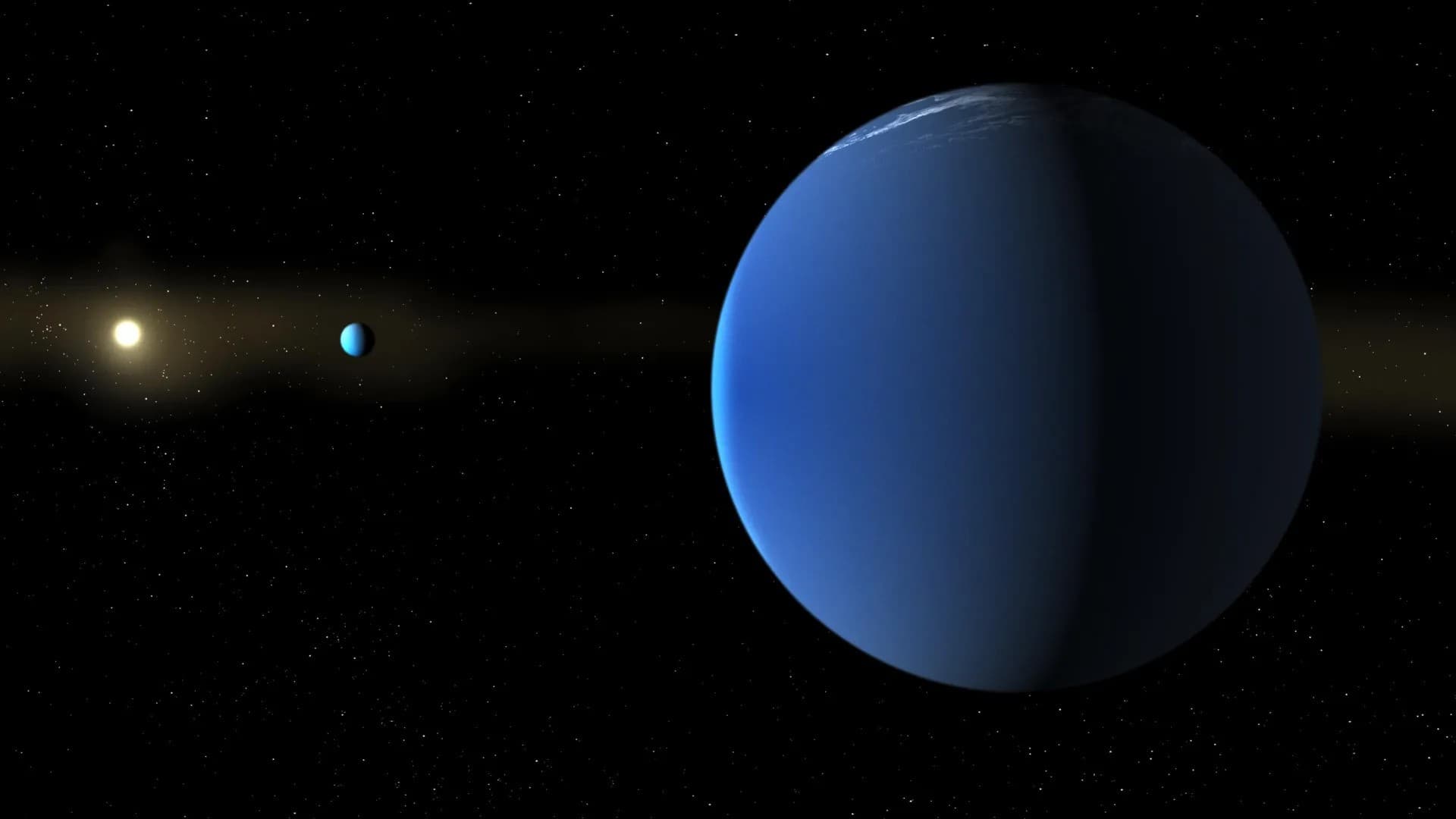
For the study, the researchers used the ASTEP (Antarctic Search for Transiting ExoPlanets) telescope to confirm the existence of two ultra-light exoplanets called TOI-791 b and Toi-791 c, which are located approximately 1,110 light-years from Earth and orbit an F-type star, which is larger and hotter than our Sun. Both exoplanets are gas giants with TOI-791 b and TOI-791 c having radii of about 1 and 1.2 of Jupiters while orbiting in about 139 and 232 days, respectively.
What makes these exoplanets intriguing isn’t their similarities to Jupiter, but their densities are lighter than the famous gas giant of our solar system. While Jupiter has a density of 1.33 grams per cubic centimeter, TOI-791 b and TOI-791 c have densities of 0.038 grams per cubic centimeter and 0.047 grams per cubic centimeter. For context, the density of cotton candy is 0.05 grams per cubic centimeter.
"This system offers a unique laboratory for understanding how super-puff planets form and evolve,” said Dr. Amaury Triaud, who is a professor at the University of Birmingham, the UK Principal Investigator of ASTEP and a co-author on the study. “We propose to carry out space-based observations using the James Webb Space Telescope to assess if the puffy atmosphere contains carbon-, nitrogen-, and oxygen-bearing species, revealing new insight into how these unusual planets formed."
What new insights into cotton candy exoplanets will researchers make in the coming years and decades? Only time will tell, and this is why we science!
As always, keep doing science & keep looking up!
Sources: Monthly Notices of the Royal Astronomical Society, ScienceDaily
Featured Illustration Credit: NASA/Daniel Rutter
About the Author
Master's (MA/MS/Other)
Laurence Tognetti is a six-year USAF Veteran who earned both a BSc and MSc from the School of Earth and Space Exploration at Arizona State University. Laurence is extremely passionate about outer space and science communication, and is the author of "Outer Solar System Moons: Your Personal 3D Journey".
You May Also Like