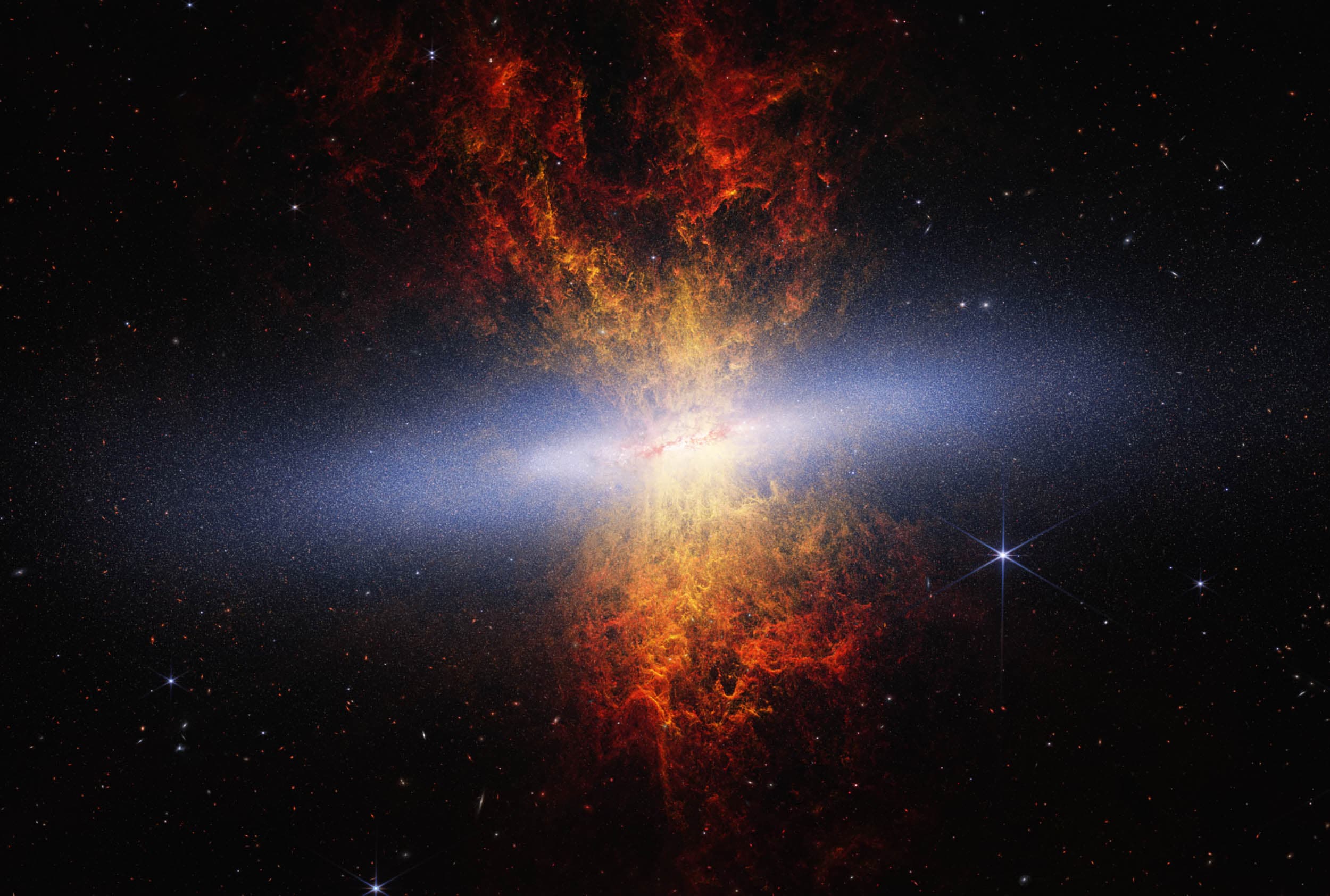
NASA’s James Webb Space Telescope has captured one of the clearest views yet of Messier 82 (M82), better known as the Cigar Galaxy.
Sitting about 12 million light-years from Earth, this edge-on spiral galaxy is going through an intense burst of star formation that astronomers believe began after a collision with another galaxy.
That busy period is expected to last only a few hundred million years, making it a brief chapter in the galaxy’s long history.
A closer look at a busy galaxy
The new survey used Webb’s Near-Infrared Camera over a total of 65 hours of observations. By detecting infrared light that passes through dust, the telescope exposed details that had never been seen before, including a stretched galactic disk and about 16.5 million individual stars.
After examining these new images, the scale of the galaxy becomes clear. The bright blue points scattered across the image mark individual stars, but they represent only a fraction of the total population.
Many more stars are simply too faint for Webb to detect.
The research was led by principal investigator Adam Smercina, a NASA Hubble Fellow at the Space Telescope Science Institute and incoming assistant professor at Tufts University.
“M82 is a mess, but it’s a beautiful mess,” he said. We don’t fully understand what’s going on, especially concerning its evolutionary history. What could have triggered such an elevated rate of star formation? How long has this galaxy been driving plumes of material away from its center?”
M82 gives scientists an ideal laboratory for studying galaxy evolution. Its unique properties reveal how stars form in extreme environments and how that activity drives powerful outflows.
Together, those processes offer insights that no other nearby galaxy can match.
Dust no longer hides the view
Astronomers have studied M82 for decades with observatories including NASA’s Hubble Space Telescope and the retired Spitzer Space Telescope.
Dust blocked much of the view, especially at high resolution. Webb’s infrared instruments changed that by seeing through the dusty regions where visible light struggles to pass.
The images also give researchers a record of events that unfolded over hundreds of millions of years. Studying stars of different ages helps scientists reconstruct when waves of star formation happened and how the galaxy changed over time.
“The sheer number of stars that we were able to resolve with Webb is incredible,” said team member Benjamin Williams of the University of Washington.
“It’s a whole different world from what we’ve been able to see with other telescopes. All of these stars collectively provide a detailed fossil record of the formation and evolution of M82.”

Signs of a turbulent past
The center of the galaxy shines more brightly than its outer regions, and its disk is noticeably uneven. One side extends farther than the other, suggesting the galaxy was pulled out of shape during a powerful merger.
Galaxy collisions are common throughout the universe and often trigger bursts of star formation by compressing enormous clouds of gas.
“At first glance, the disk of the galaxy may seem less spectacular because Webb sees through the dust,” said team member Eric Bell of the University of Michigan.
“But M82 is a delightfully complex system. Webb’s observations will help us address some ongoing mysteries, such as how star formation has moved within M82 over the last few billion years.”
The Cigar Galaxy forms stars at a rate about 10 times faster than the Milky Way. That rapid pace cannot continue forever.
Massive young stars release intense radiation and powerful stellar winds, while exploding stars add even more energy. Together, these processes push gas away from the galaxy’s center, gradually removing the raw material needed to create future generations of stars.
Webb captured these giant outflows rising above and below the galaxy’s disk in an hourglass shape. The yellow strands closest to the disk represent ionized gas, while the orange material farther out consists of tiny dust particles known as polycyclic aromatic hydrocarbons.
These particles help astronomers trace the interstellar medium, the gas and dust that fill the space between stars.
Many telescopes, one bigger picture
The Webb observations answer some questions but also raise new ones.
Astronomers expect to combine these images with data collected by other space telescopes to better understand how the Cigar Galaxy evolved and why it remains one of the most active star-forming galaxies in the nearby universe.
The researchers noted that galaxies are intricate ecosystems, so understanding them requires combining data from multiple space missions.
No single mission can answer every question about the Cigar Galaxy. By combining observations from telescopes such as Webb and Hubble, scientists can investigate more of the galaxy’s features and tackle increasingly complex questions.
—–
Like what you read? Subscribe to our newsletter for engaging articles, exclusive content, and the latest updates.
Check us out on EarthSnap, a free app brought to you by Eric Ralls and Earth.com.
—–