Space travel has not one but many challenges. Chief among these is the requirement that a spacecraft carry its entire fuel supply from the moment of launch. It’s the ultimate version of over-packing for a road trip. But what if the future missions could pull over to fill up instead?
US space agency recently revealed a major milestone in its quest to build “gas stations” in orbit.
NASA is developing and testing a specialized device called a cryocoupler to enable future deep-space exploration missions to refuel at orbital propellant depots.
This specialized hardware is designed to securely connect spacecraft to orbital propellant depots. It enables the automated transfer of super-cold fluids such as liquid hydrogen and liquid oxygen chilled to hundreds of degrees below zero.
“In-orbit cryogenic refueling between two spacecraft has yet to be done and remains one of the toughest engineering challenges in spaceflight,” said Travis Belcher, cryocoupler project manager at NASA’s Marshall Space Flight Center in Huntsville, Alabama.
“These propellant transfers are essential for the kinds of missions NASA wants to fly in the future, so developing a coupler that can handle ultra-cold propellants is a critical step toward making that capability real,” Belcher added.
NASA’s cryocoupler testing
The process of transferring cryogenic fluid in a vacuum is highly difficult, especially when handling liquid hydrogen and liquid oxygen. These substances that must be kept at hundreds of degrees below zero Fahrenheit to remain stable.
If the seals fail or materials become brittle and shatter under the thermal shock, the entire mission is at risk.
The terrestrial fueling hardware designed for the Artemis program’s Space Launch System rockets simply cannot function in an orbital environment. These couplers are heavy, designed to be detached during the violent shaking of a launch. In orbit, there’s a need for something lighter, cleaner, and fully automated.
Developed in partnership with L3Harris, the new cryocoupler is designed to be the orbital equivalent of a nozzle at a fuel pump. It will be able to connect two ships and create a secure, leak-proof bridge between them.
“The cryocouplers we’re working on can attach and detach multiple times and are fully automated, so astronauts won’t have to perform a spacewalk to transfer propellant,” said Belcher. “They’re rigorously designed to withstand space and sized for the expected tank designs.”
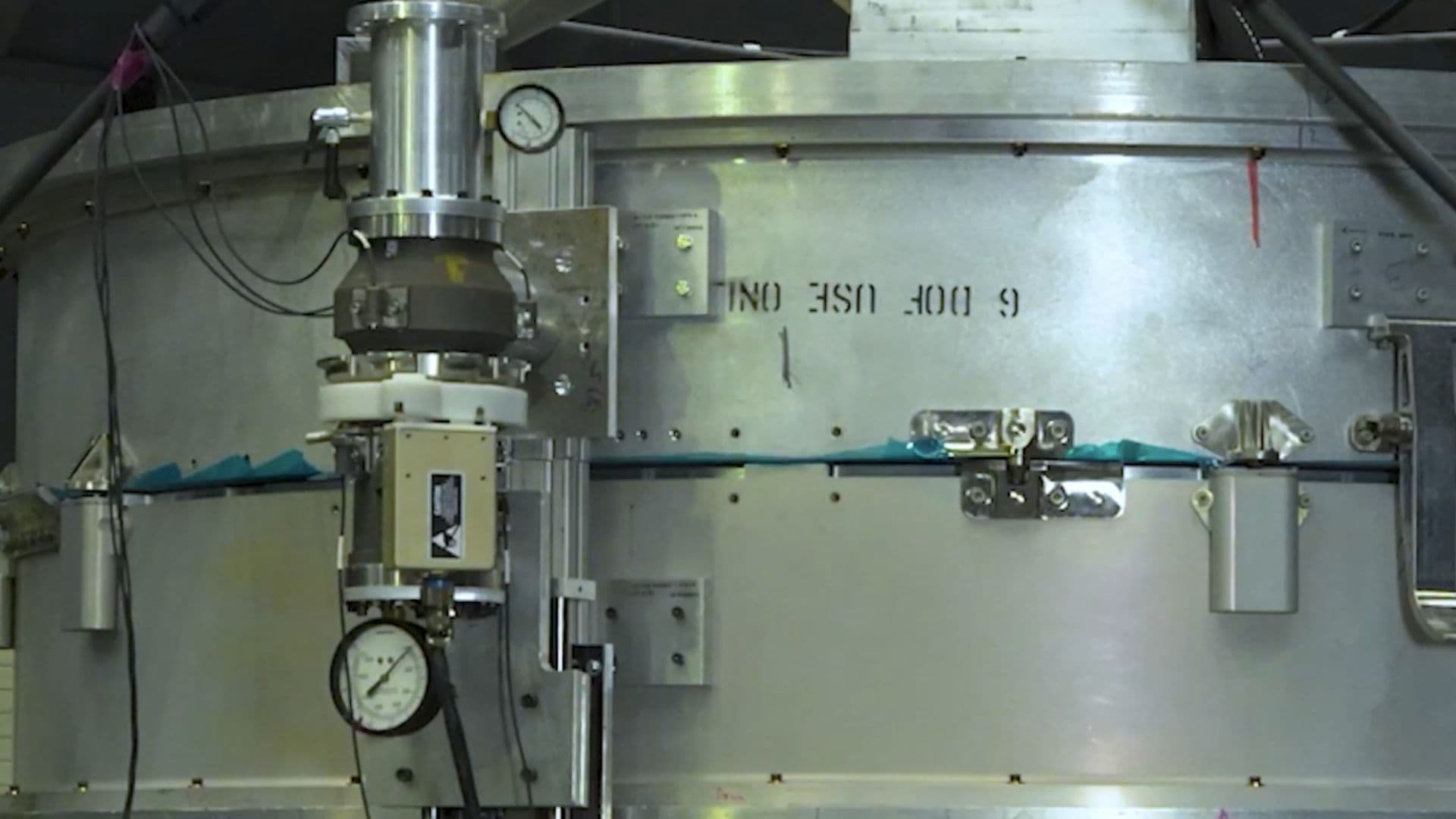
During recent testing at NASA’s Marshall Space Flight Center, engineers used a robotic table to simulate the real-world challenges of docking two massive, moving spacecraft in orbit.
In space, vehicles rarely align perfectly. Hence, the team deliberately created misaligned docking scenarios to demonstrate that the coupler could still adjust, securely connect, and maintain its seal even when slightly askew.
Testing sets up foundation for the future
A joint NASA and L3Harris team also conducted thermal testing on the cryocoupler by running liquid nitrogen at -321°F through various connected and disconnected setups.
These tests evaluated how the hardware, seals, and fluid flow handle extreme thermal contraction and the intense temperature differences between the freezing propellant and the coupler materials.
The current tests are foundational, which prove the concept works, but are only the beginning.
NASA plans to iterate on these designs to meet the specific requirements of upcoming lunar and Martian architectures.

Get the latest in engineering, tech, space & science - delivered daily to your inbox.
Mrigakshi is a science journalist who enjoys writing about space exploration, biology, and technological innovations. Her work has been featured in well-known publications including Nature India, Supercluster, The Weather Channel and Astronomy magazine. If you have pitches in mind, please do not hesitate to email her.