Nearly every galaxy in the universe is wrapped in far more dark matter than starlight. The invisible stuff outweighs the stars by ten or a hundred to one, and in the smallest galaxies its grip is supposed to be strongest of all. So a galaxy that behaves as though it has almost none is not a minor curiosity. It is a puzzle about how galaxies are built.
Astronomers have now found a third one. Using the W. M. Keck Observatory on Maunakea, a Yale-led team measured the internal motions of a faint, diffuse galaxy called NGC 1052-DF9 and found its stars moving too slowly to hide a normal dark matter halo. The galaxy joins two earlier oddballs, DF2 and DF4, and all three lie along the same narrow line of galaxies in the NGC 1052 field. The discovery was announced by Keck Observatory and the study appears in The Astrophysical Journal.
How you weigh a galaxy you cannot touch
The trick is that stars orbit inside a galaxy at a speed set by everything pulling on them. Pack in a heavy, invisible halo and the stars whip around fast. Take the halo away and the same stars drift slowly, held only by each other and by the light you can see.
Across two nights the team collected nearly eleven hours of exposures with Keck’s Cosmic Web Imager, split between DF9 itself and patches of nearby empty sky used to subtract the atmosphere’s glow. Then they read the spread of stellar velocities from the blur in the galaxy’s combined starlight. After correcting for effects that can fatten that blur artificially, they measured a velocity dispersion of about 6.5 kilometers per second, with a wide margin on either side.
That is a small number, and a telling one. A galaxy of DF9’s stellar mass would need a dispersion near 8 kilometers per second if its stars provided all the gravity, and the measured value agrees with that expectation within its wide error bars. If DF9 sat inside the dark matter halo that galaxies its size normally carry, the stars should be moving at roughly 24 kilometers per second, and by some estimates faster still. They are not.
A galaxy that weighs only its stars
Turned into a mass, DF9 comes out at only about 100 million times the mass of the Sun, essentially all of it accounted for by the stars themselves. A galaxy that size would ordinarily sit in a halo around a hundred times heavier. That halo appears to be missing.
DF2 and DF4 caused a stir for the same reason when van Dokkum and colleagues announced the first galaxy lacking dark matter in 2018, and a second the following year. Both were spread thin, both held strangely luminous star clusters, and both weighed little more than their starlight. What has changed is that they are no longer isolated weird cases. They are points on a line.
The straight line is the real clue
A few years ago the same group noticed that DF2 and DF4 were not alone. About a dozen faint galaxies in the field fall along a remarkably tight, straight trail, and follow-up work showed their velocities increase steadily along its length, as though they were flung out together. DF9 is the trail member that most closely resembles DF2 and DF4, and it is the only one of the remaining trail galaxies still bright enough for its internal motions to be measured.
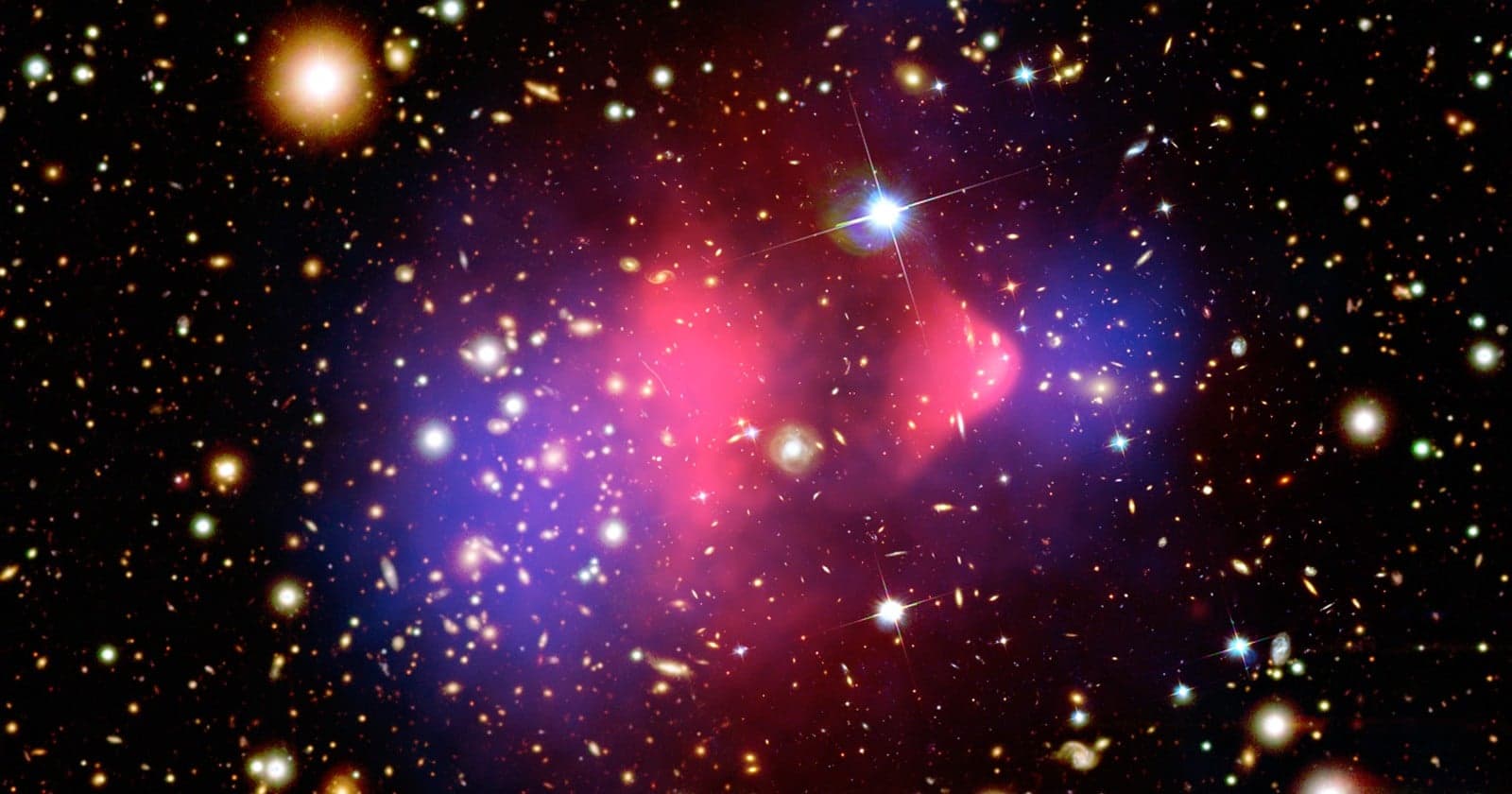
That geometry points to a specific and dramatic origin. In one leading idea, two gas-rich galaxies slammed into each other at high speed long ago. The dark matter of each passed straight through, because dark matter barely interacts with anything, while the ordinary gas piled up, shocked and compressed, and later collapsed into a string of small galaxies made almost entirely of normal matter. It is a dwarf-scale echo of the Bullet Cluster, where a collision was seen to separate a cluster’s visible gas from its dark matter.
If that story is right, it makes a sharp prediction: the other galaxies on the trail should also be short on dark matter, because they formed from the same stripped gas. DF9 is the first test of that prediction beyond the original two, and it passed. As lead author Michael Keim put it in the Keck announcement, the three galaxies now look like “extraordinary exceptions” that “formed together in a violent event that separated ordinary matter from dark matter.”
What a measurement this delicate can settle, and what it cannot
The headline is genuinely strong, but it rests on a signal near the limit of what a telescope can measure, so it is worth being precise about what the number does. The uncertainty on that 6.5 figure runs several kilometers per second in each direction. The finding is that DF9’s motion is consistent with its stars alone and inconsistent with a full dark matter halo. That is not the same as proving the halo is exactly zero. A modest amount of dark matter still fits inside the error bars; a normal amount does not.
The measurement also depends on subtracting effects that have nothing to do with gravity, such as the natural broadening of starlight and the jostle of stars in binary pairs, both estimated from other galaxies rather than measured directly in DF9. And the mass rests on the light of a whole galaxy blended together, not on hundreds of individual stars, which is the cleaner but currently impossible way to do it at this distance. The authors are careful on one point in particular: their consistency check from two star clusters can rule out a no-dark-matter model if the clusters move fast, but it can never rule dark matter out. The evidence leans one way, and it leans hard, but a single delicate dispersion is not a closed case.
There is also more than one way to make a galaxy without dark matter. A high-speed bullet-dwarf collision is the explanation the trail’s discoverers favor, and simulations reproduce its tight geometry, but other groups argue these dwarfs could instead be tidal dwarfs, small galaxies condensed from the ordinary-matter debris of a long-ago merger between two massive galaxies, born without dark matter of their own. A galaxy formed that way would be missing its halo just the same, so the new measurement does not by itself decide between the two stories. What the collision picture alone predicted in advance was the trail itself, and that is what keeps it in front.
Why a missing halo is worth the trouble
The deeper reason astronomers care is almost the opposite of what the headline suggests. Finding galaxies without dark matter is, oddly, some of the better evidence that dark matter is real. If gravity simply behaved differently in faint galaxies, as some alternative theories propose, then every galaxy of a given size should show the same anomaly. Instead a few galaxies, all apparently born in the same collision, stand out from thousands of ordinary ones. Dark matter that can be left behind in a crash is dark matter that exists as a substance, not as a quirk of the equations.
The way to settle it still runs down the trail, but not by weighing more galaxies; the study’s authors note the remaining members are so faint that their internal motions sit beyond the reach of optical spectroscopy. The more promising hunt is for gas. If the collision really happened, some of the gas it stripped may still lie along the trail, and spotting it would be what the authors call “smoking gun” evidence. Find that, and a strange line of galaxies in a single field will have become one of the sharpest tests yet of what dark matter actually is.